The Burgenland affair centres on one rock: serpentinite, the source of gravel quarried in several southern Burgenland quarries that contains asbestos. The Burgenland page summarises the geology briefly. This post gives the full version: how serpentinite forms, why it contains asbestos, which forms of asbestos occur, and why the Rechnitz Window in particular is affected. Every statement is backed by a primary source; the full citations are at the end.
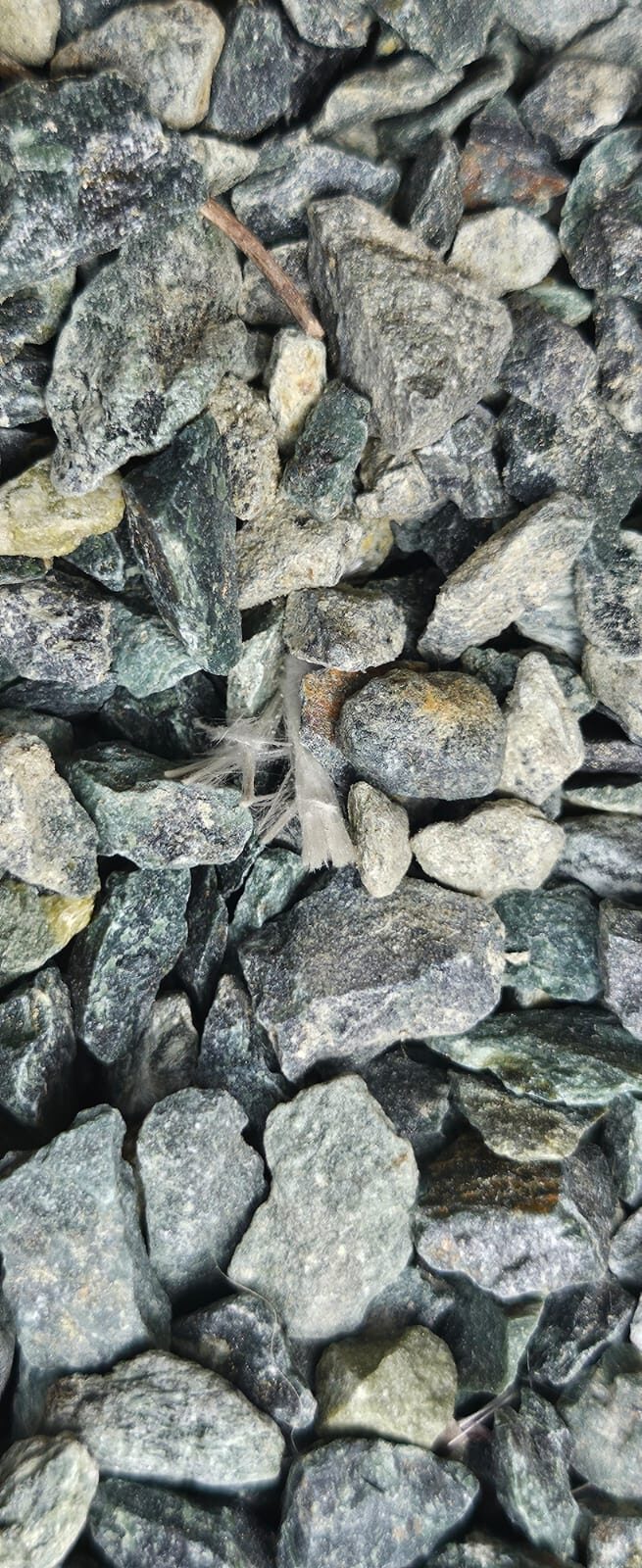
What is serpentinite?
Serpentinite is a metamorphic rock derived from ultramafic parent material. Ultramafic rocks consist mainly of the iron- and magnesium-rich minerals olivine and pyroxene and originate in the upper mantle. When such rock comes into contact with water, an alteration takes place that geologists call serpentinization: a form of metasomatism in which the original iron-magnesium minerals are rebuilt into water-bearing magnesium silicates of the serpentine group (Van Gosen and Clinkenbeard 2011). Metasomatism here means an alteration process in which a fluid flowing through the rock changes its chemical composition. The result is serpentinite, a rock made up mainly of serpentine minerals.
For experts (or the expert-curious): serpentinization reactions and the redox/H₂ budget
In the pure magnesium system, the hydration of olivine is described by the model reaction 2 Mg₂SiO₄ + 3 H₂O = Mg₃Si₂O₅(OH)₄ + Mg(OH)₂, that is, forsterite plus water to serpentine plus brucite (Frost and Beard 2007, reaction 13; Klein et al. 2009, reaction R13). If additional SiO₂ is available, for instance from the simultaneous hydration of orthopyroxene, the reaction proceeds via 3 Mg₂SiO₄ + 2 SiO₂ + 4 H₂O = 2 Mg₃Si₂O₅(OH)₄ and serpentine forms without brucite (Frost and Beard 2007, reaction 8; cf. Klein et al. 2009, reaction R12). Brucite is therefore not an obligatory phase but one that depends on the silica supply and is often cryptic.
The governing quantity is the silica activity aSiO₂, the chemical driving force of silica relative to quartz. It controls which mineral assemblage is stable: as aSiO₂ rises, the equilibrium shifts from brucite (Mg₃Si₂O₅(OH)₄ + H₂O = 3 Mg(OH)₂ + 2 SiO₂, Frost and Beard 2007, reaction 9) through serpentine toward talc (Mg₃Si₂O₅(OH)₄ + 2 SiO₂ = Mg₃Si₄O₁₀(OH)₂ + H₂O, reaction 7). Serpentinites are among the most silica-poor rocks of the Earth's crust: in an equilibrium of olivine, serpentine and brucite, aSiO₂ is around 10−2.5, and across the serpentinite system as a whole it lies between about 10−2.5 and 10−5 (Frost and Beard 2007).
The redox budget hangs on this. The Fe²⁺ bound in olivine is oxidized to Fe³⁺ and fixed predominantly in secondary magnetite, and alongside that in the serpentine itself; the oxygen required is supplied by the decomposition of water (2 H₂O = 2 H₂ + O₂), which releases H₂ (Frost and Beard 2007; Klein et al. 2009). The oxidation can be written via the iron serpentine end-member component: 2 Fe₃Si₂O₅(OH)₄ + O₂ = 2 Fe₃O₄ + 4 SiO₂ + 4 H₂O, equivalently in its hydrogen-producing form Fe₃Si₂O₅(OH)₄ = Fe₃O₄ + 2 SiO₂ + H₂O + H₂ (Frost and Beard 2007, reaction 23; Klein et al. 2009). The hydrogen thus generated makes serpentinites the most strongly reduced rocks of the Earth's crust, reducing enough that partially serpentinized peridotites can carry metallic iron-nickel alloys such as awaruite (FeNi₃) (Frost and Beard 2007).
The less obvious conclusion: aSiO₂ controls not only the mineral assemblage but also the distribution of iron and hence the hydrogen yield. At high silica activity, magnetite is not stable; the iron remains bound in iron-rich serpentine and brucite, and less H₂ forms. Only at low aSiO₂ does magnetite crystallize alongside magnesium-rich serpentine and brucite, which drives H₂ production (Frost and Beard 2007). In the mesh textures of abyssal serpentinites, accordingly, a substantial part of the iron is trivalent: about 30 to 50 percent in the serpentine-brucite rims (Klein et al. 2009).
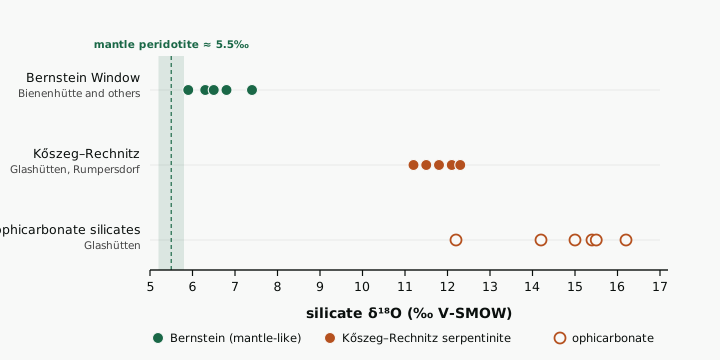
At Rechnitz: for the serpentinites of Glashütten and Rumpersdorf in the Kőszeg-Rechnitz Window (δ¹⁸O up to 12.3 ‰) as well as the silicates of the ophicalcites (up to 16.2 ‰), Demény et al. (2007) demonstrate a strong ¹⁸O enrichment and interpret it as the result of low-temperature serpentinization or of interaction with ¹⁸O-rich fluids, in contrast to the mantle-near δ¹⁸O values (5.9 to 7.4 ‰) of the rocks of Bienenhütte in the Bernstein Window.
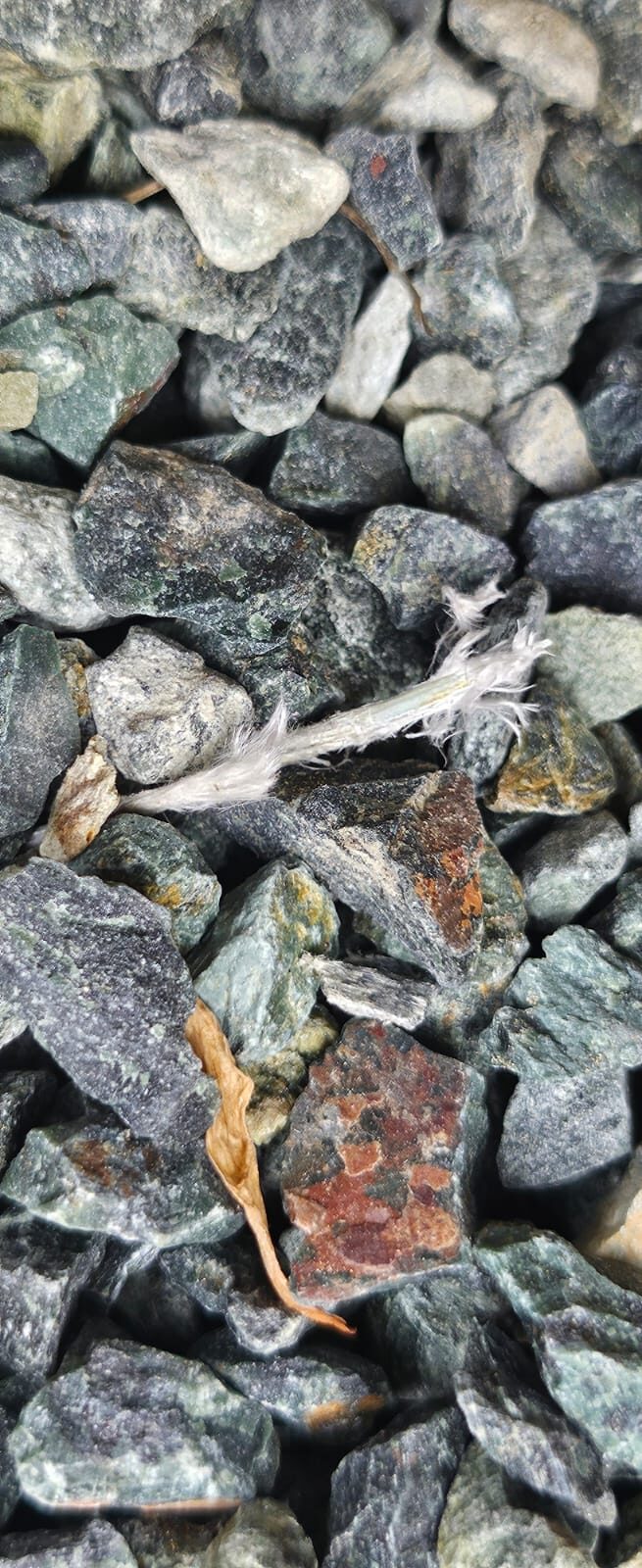
Three minerals, one formula: lizardite, antigorite, chrysotile
The serpentine group comprises three rock-forming minerals with almost identical chemical formula (Mg₃Si₂O₅(OH)₄) but different crystal structure: lizardite, antigorite and chrysotile (Evans 2004). All three are sheet silicates, built from stacked layers. The difference lies in the shape of those layers. In lizardite they lie flat, in antigorite they are wave-modulated, in chrysotile they are curved and roll up into fine tubes. It is exactly this curvature that turns a sheet silicate into a fibrous mineral (Evans 2004): chrysotile is the asbestiform form of serpentine, known industrially as "white asbestos" and by far the most common asbestos worldwide (Van Gosen and Clinkenbeard 2011). "Asbestiform" denotes growth in thin, flexible, individually separable fibres.
For experts (or the expert-curious): the TO-sheet misfit and why the sheet curves
All three serpentine polymorphs are trioctahedral sheet silicates of the 1:1 or TO type: one tetrahedral [SiO₄] sheet is linked to exactly one brucite-like, trioctahedral [Mg(O,OH)₆] octahedral sheet (Wicks and O'Hanley 1988). The key to the three structural forms is a geometric incompatibility of the two sheets: the lateral dimension of an ideal magnesium-occupied octahedral sheet (b ≈ 9.43 Å) is larger than that of an ideal silicon-occupied tetrahedral sheet (b ≈ 9.1 Å). This misfit is considerable and generates a strain that each of the three structures resolves differently (Wicks and O'Hanley 1988). The same substance, the same strain, three solutions: a platy, a tube-shaped fibrous and a wavy mineral.
Lizardite stays planar. It bridges the misfit within the flat sheet, chiefly through a ditrigonal rotation of the tetrahedra, which according to Wicks and O'Hanley (1988) is the essential mechanism, together with limited coupled substitution of Al³⁺ and Fe³⁺ for Mg and Si, for example after (Mg₆₋ₓAlₓ)(Si₄₋ₓAlₓ)O₁₀(OH)₈; at an Al content of x ≈ 0.6 the lateral areas of the two sheets exactly match (Wicks and O'Hanley 1988; cf. Evans 2004). Chrysotile, by contrast, resolves the misfit through curvature: the sheet rolls up into concentric or spiral cylinders, with the larger octahedral sheet on the outside, on the convex side of the arc (Wicks and O'Hanley 1988). Intralayer strain is lowest at a radius of curvature of about 88 Å (Whittaker 1957, cited in Evans 2004); real fibres have outer radii of around 110 to 135 Å (Yada 1971, cited in Wicks and O'Hanley 1988). It is precisely this curved layer structure that, according to Evans (2004), turns a sheet silicate into a fibrous mineral.
Antigorite takes a third path: a modulated structure built from an alternating wave in which the tetrahedral sheet runs continuously but reverses its polarity, that is, the direction of curvature, at the inflection points; this reversal repeats periodically and forms a superstructure (Wicks and O'Hanley 1988). Its wavelength A is not fixed but usually lies at about 33.7 to 43.1 Å (Wicks and O'Hanley 1988); the periodicity parameter m denotes the number of tetrahedra per superperiod (Kunze 1961, cited in Wicks and O'Hanley 1988). At every curvature reversal, 3 Mg and 6 (OH) are missing per unit cell relative to Si, which is why the formula of antigorite deviates from the ideal serpentine formula and comes out somewhat more silicon-rich and magnesium-poor (Wicks and O'Hanley 1988). The less obvious conclusion: chrysotile's fibrous, health-relevant habit is a crystallographic consequence of strain release, not a matter of chemical composition.
At Rechnitz: for the fully serpentinized ultramafic bodies in the windows of Bernstein, Rechnitz and Eisenberg, Koller (1985) demonstrates by X-ray diffraction lizardite and chrysotile together as the essential mineral content, chrysotile among other things in mesh texture. In the same rocks, then, the planar and the rolled-up resolution of the same misfit occur side by side; asbestos, according to Koller, is relatively often present on the open fracture surfaces.
![Schematic of the serpentine 1:1 or TO layer: a narrower tetrahedral sheet [SiO₄] on a wider brucite-like octahedral sheet [Mg(O,OH)₆], whose lateral dimension b ≈ 9.43 Å is larger than that of the tetrahedral sheet (≈ 9.1 Å). The resulting misfit is resolved differently by the three minerals: lizardite stays planar, chrysotile curls into a tube with the larger octahedral sheet on the outside, antigorite forms a modulated wave.](/img/blog/serpentinit/serpentine-to-misfit-en.svg)
Phase relations and the metastability of chrysotile
Which serpentine phase forms depends on temperature, pressure and the conditions under which the mineral grows. Lizardite and chrysotile occur at low temperatures, from near-surface conditions up to about 400 °C; lizardite is the more stable phase at low temperatures (Evans 2004). Antigorite is the high-temperature form: between roughly 320 and 390 °C lizardite is progressively replaced by antigorite, above about 390 °C antigorite is the only stable serpentine mineral, until secondary olivine begins to grow at around 460 °C (Schwartz et al. 2013).
Chrysotile, by contrast, is according to Evans (2004) under no conditions the thermodynamically most stable phase, that is, metastable (not the most stable form in the long run, but kinetically preserved). What governs its occurrence, according to Evans, is less temperature and pressure than the circumstances of its growth: chrysotile forms preferentially in fluid-filled voids and in fractures, usually only after the active hydration of the surrounding rock mass has ceased. This is why the same geological process leaves fibrous chrysotile in one rock and mainly the flat-layered lizardite in another.
For experts (or the expert-curious): the serpentine multisystem and why chrysotile is ubiquitous despite being metastable
Which of the serpentine phases belongs in the phase diagram of the system MgO-SiO₂-H₂O (MSH) at crustal conditions is the core question of Evans (2004). His finding: chrysotile is nowhere the most stable phase. Lizardite is marginally more stable at low temperatures, yet the difference in Gibbs energy in the range 300 to 400 °C amounts to no more than about 2 kJ; above about 300 °C, antigorite + brucite is more stable than both (Evans 2004). This gap is small compared with the natural scatter of the Gibbs energy of lizardite itself, which on account of surface energy, polytypism and crystal defects reaches several hundred joules per mole; minimally strained chrysotile with a radius of curvature of about 90 Å can even be more stable than lizardite, while strongly strained chrysotile (≈ 200 Å) cannot (Evans 2004).
What is decisive, therefore, is not thermodynamics but kinetics. Chrysotile grows preferentially in isotropically strained, fluid-filled voids and pores as well as in veins, usually only after the active hydration of the surroundings has ended; Evans models the chrysotile veins in lizardite- or antigorite-bearing rock as nucleation of weakly strained chrysotile followed by kinetically favoured accretion of higher-energy layers under mild fluid supersaturation (Evans 2004). Lizardite, by contrast, forms by replacement under the expansion pressure of hydration. Because chrysotile is promoted by fluid and not by shear stress, the two behave like a strain-antistrain pair that can grow side by side in the same partially or fully serpentinized rock (Evans 2004).
From this follows the less obvious conclusion: it is not temperature and pressure but the circumstances of growth that decide whether chrysotile or lizardite forms (Evans 2004). Where fibrous chrysotile, the white asbestos, occurs, it marks the pathways along which fluids found open space, not a particular pressure-temperature position. The asbestos content of a serpentinite thus follows its fluid and fracture history, not the equilibrium phase diagram.
At Rechnitz: Koller (1985) finds the asbestos of the Rechnitz serpentinites above all on the open fracture surfaces, precisely in the fluid-conducting openings that, according to Evans, favour the growth of chrysotile. The Eo-Alpine metamorphism of the Rechnitz series at 330 to 370 °C lies in the transitional range in which lizardite is progressively replaced by antigorite (Schwartz et al. 2013).
Why the asbestos content varies
Asbestos is not evenly distributed in serpentinite. Chrysotile veins grow in fractures and shear zones, where fluids were able to circulate through the rock (Evans 2004). According to Van Gosen and Clinkenbeard (2011), asbestos occurrences are, even in suitable rocks, confined to those areas where several formation conditions coincided: microfracturing, an influx of silica-rich fluids and appropriate pressure-temperature conditions. Unlike the question of which serpentine phase grows, what decides whether asbestos forms at all is the local interplay of these conditions. Because they vary on a small scale, so does the asbestos content: samples from the same quarry can yield a few percent in one measurement and a multiple of that in another. At the same time, again per Van Gosen and Clinkenbeard, at least small amounts of asbestos are very commonly present in metamorphosed ultramafic rocks. For the Rechnitz serpentinites, Koller (1985) records explicitly that talc, tremolite and asbestos are relatively often present on fracture surfaces.
Amphibole asbestos: tremolite and actinolite
Not all asbestos is chrysotile. The metamorphism of ultramafic rocks can also form amphibole asbestos (Van Gosen and Clinkenbeard 2011). The typical amphibole asbestos minerals in serpentinite occurrences are tremolite and actinolite (Van Gosen and Clinkenbeard 2011). For the Rechnitz Window itself, Koller (1985) documents tremolite in tectonically reworked zones and on fracture surfaces; actinolite has been detected in Burgenland material, among other places in one of our own samples (see Own sampling).
This distinction is more than a mineralogical subtlety. Amphibole asbestos is considered epidemiologically more potent than chrysotile; we set out the evidence and the limits of that statement on the standards page (Asbestos standards, section 5). There we also address the analytically tricky question of whether an acicular amphibole particle grew asbestiform or is a cleavage fragment, since both can meet the same geometry.
For experts (or the expert-curious): the double-chain crystal chemistry of the amphiboles and why asbestiform and cleavage fragment can become indistinguishable
Amphiboles are chain silicates, and in contrast to the single chains of the pyroxenes they are double-chain silicates: the silicate framework consists of a double chain of corner-linked tetrahedra joined to a band of edge-linked octahedra, both extended along the c-axis (Hawthorne and Oberti 2007). Per formula unit this double chain comprises eight tetrahedra, T₈O₂₂, that is, two single chains of the repeat-unit type Si₄O₁₁ that grow together via the bridging oxygens O(5), O(6) and O(7) into the double chain (Hawthorne and Oberti 2007). Hawthorne and Oberti (2007) write the general amphibole formula as A B₂ C₅ T₈ O₂₂ W₂ with four cation sites: A sits at the centre of a large cavity between the back-to-back double chains and takes up Na, K, Ca, Li or a vacancy (□); the B cations (Na, Li, Ca, Mn²⁺, Fe²⁺, Mg) occupy the M(4) site at the edge of the octahedral band; the C cations (Mg, Fe²⁺, Mn²⁺, Al, Fe³⁺, Mn³⁺, Ti⁴⁺, Li) fill the three octahedrally coordinated sites M(1), M(2) and M(3) in the interior of the band; T stands for the tetrahedral cations Si, Al and Ti⁴⁺, and W for the anions (OH), F, Cl or O²⁻ on the O(3) position (Hawthorne and Oberti 2007).
Tremolite and actinolite are, in this scheme, a complete solid-solution series of the calcic amphiboles. The tremolite end-member □Ca₂Mg₅Si₈O₂₂(OH)₂ has an empty A site, Ca₂ on B = M(4) and Mg₅ on C = M(1) to M(3) (Hawthorne and Oberti 2007). From there the coupled isovalent substitution Fe²⁺ ⇌ Mg on the C sites, that is the Fe²⁺-Mg distribution across the octahedral sites M(1) to M(3) (Hawthorne and Oberti 2007), leads continuously to the iron-rich end-member □Ca₂Fe²⁺₅Si₈O₂₂(OH)₂. Tremolite and actinolite thus differ solely in the Mg/Fe²⁺ ratio of the octahedral sites, not in the structural principle of the double chain.
From this follows the point decisive for the asbestos question. An amphibole that grew asbestiform, formed in thin, flexible, individually separable fibres, and a cleavage fragment, produced by the breaking of a massive or prismatic crystal along its cleavage, can carry the same chemical composition, because the composition resides in the occupancy of the A, B, C and T sites, not in the habit. Both can at the same time fall into the same elongate particle geometry. Nevertheless they formed in crystal-chemically different ways: the one as directed fibre growth, the other as a fragment. It is precisely this decoupling of composition and geometry on the one hand from genesis on the other that makes the identification and counting of amphibole fibres analytically tricky. The counting-related and regulatory side of this distinction we address on the standards page, section 5.
At Rechnitz: Koller (1985) documents in the serpentinites of the Rechnitz series tremolite above all in tectonically reworked zones and on the open fracture surfaces, and he assigns to the youngest, greenschist-facies metamorphic event dark-blue alkali amphiboles of riebeckitic to Mg-riebeckitic composition. In the local sequence, then, the calcic amphibole tremolite, whose actinolitic counterpart has been detected in Burgenland material, and the sodium-bearing riebeckite-magnesioriebeckite occur side by side.
For experts (or the expert-curious): the geochemistry of biodurability, why chrysotile dissolves and amphibole asbestos resists
That a fibre remains in the tissue is, according to Hume and Rimstidt (1992), not a question of equilibrium solubility but of dissolution kinetics. The fluids in lung tissue contain very low magnesium and silicon concentrations and are markedly undersaturated with respect to chrysotile; thermodynamically, then, chrysotile ought to dissolve, and its persistence is "simply a result of a slow dissolution rate" (Hume and Rimstidt 1992). The governing reaction at pH < 9 is Mg₃Si₂O₅(OH)₄ + 6 H⁺ = 3 Mg²⁺ + 2 H₄SiO₄ + H₂O (Hume and Rimstidt 1992). It proceeds in two steps: first the brucite-like magnesium hydroxide sheet of chrysotile is leached out rapidly, leaving behind a silicate framework whose slower dissolution then controls the overall rate. The fibre lifetime, that is, the biodurability, therefore depends on the rate of silica release (Hume and Rimstidt 1992). For the undersaturation range prevailing in lung tissue, this rate is independent of pH and amounts to 5.9 (± 3.0) × 10⁻¹⁰ mol m⁻² s⁻¹ at 37 °C (Hume and Rimstidt 1992).
It is exactly here that the kinetics connects with the crystal structure. The sheet that gives way first and fast is the same outer, brucite-like Mg(OH) octahedral sheet of the TO sheet that, in the rolled chrysotile fibre, lies on the convex outer side of the arc and is thus exposed to the fluid (cf. the TO-sheet section above; Wicks and O'Hanley 1988). The amphiboles offer the fluid no such freely accessible hydroxide sheet: in the amphibole double chain the magnesium and iron cations sit on the octahedral sites M(1), M(2) and M(3) in the interior of the octahedral band, enveloped by the silicate framework of the corner-linked double chain T₈O₂₂ (cf. the double-chain section above; Hawthorne and Oberti 2007). Structurally it follows that the kinetically decisive first step, the rapid leaching of an exposed Mg hydroxide sheet, lacks its surface of attack in the amphiboles; the attackable part is here built into the more resistant silicate framework. This is a structural inference from the two structural plans, not a measurement: for iron-rich amphiboles such as crocidolite, no measured dissolution rates are available according to Hume and Rimstidt (1992). How far the greater durability explains the differing harmfulness we set out on the standards page.
The less obvious conclusion: biodurability is the geochemical reason why the same hazard class splits apart along mineralogy. The leachable Mg sheet makes chrysotile less biopersistent than the framework-built silicates; as an order of magnitude, Hume and Rimstidt (1992) give a modelled lifetime of 9 (± 4.5) months for a chrysotile fibre of 1 µm diameter, against 438 years for an equally large fibre of amorphous silica and 1.7 × 10⁶ years for a quartz grain of the same size. This is why the local amphibole finding, tremolite and actinolite, carries its own weight; the epidemiological side of this weighting is on the standards page, section 5.
At Rechnitz: in the Rechnitz rocks both kinds of asbestos occur, the chrysotile of the serpentine (Koller 1985; see the TO-sheet section above) and the amphibole asbestos tremolite or actinolite (Koller 1985), whose actinolitic member is detected in one of our own samples (see Own sampling). By the biodurability logic, the amphibole asbestos is the more durable of the two; the health weighting of this difference is on the standards page.
The Rechnitz Window
The four closed quarries lie within the geological context of the Rechnitz Window. A tectonic window is an erosionally exposed area in which deeper rock units come to the surface, surrounded by younger nappes that still overlie them. In the Rechnitz Window, Penninic rock series emerge beneath the Austroalpine nappes (Koller 1985). This "Rechnitz series" consists of phyllites, calcareous phyllites, quartzites and substantial ophiolite complexes; the ophiolites are made up of serpentinized ultramafic rocks, metagabbros and greenschists (Koller 1985). Ophiolites are remnants of former oceanic crust (here of the Penninic ocean) that were incorporated into the continental margin during the Alpine orogeny.
Koller (1985) reconstructs a multi-stage metamorphic history for these rocks: an oceanic event, an Eo-Alpine high-pressure phase under blueschist conditions (330 to 370 °C at 6 to 8 kilobar) and a younger, Tertiary regional metamorphism. The oceanic parent material was thus carried to depth during the Alpine orogeny, transformed under high pressure and later overprinted again.
For experts (or the expert-curious): the metamorphic P-T-t path, the geodynamics and the protolith geochemistry of the Rechnitz Window
Each of Koller's (1985) three stages carries its own diagnostic mineral assemblage, and together they trace a path from oceanic crust into the subduction zone and back. The oceanic metamorphism is marked by high-temperature hornblende phases, namely barroisite, pargasite and magnesiohornblende, accompanied by metasomatic changes (Na, Ca influx) and intense oxidation; Koller (1985) brackets it at 750 to below 400 °C at a pressure of at most 1 kilobar and interprets the widespread metamorphic traces as evidence of a mid-ocean ridge with relatively low spreading rates. It is the imprint the rock acquired on the sea floor itself.
The Eo-Alpine high-pressure low-temperature stage is the tectonic memory of the burial. Its index minerals are Mg-rich pumpellyite, ferroglaucophane, an alkali pyroxene of composition around Ac63Jd21, lawsonite (preserved only as pseudomorphs) and stilpnomelane; from this paragenesis Koller (1985) derives 330 to 370 °C at 6 to 8 kilobar, and a K-Ar dating on zoned crossite-riebeckite mixed crystals gave 65 ± 6 million years. These conditions require, according to Koller (1985), a Cretaceous burial of the Penninic oceanic crust in a subduction zone to depths of at least 15 to 25 kilometres; the low geothermal gradient corresponds exactly to that of a subduction zone. The youngest, greenschist-facies regional metamorphism overprints this high-pressure fabric at 390 to 430 °C and less than 3 kilobar (K-Ar 19 to 22 million years); its index minerals are actinolite, an alkali pyroxene with a small jadeite component (Ac85Jd<5) and dark-blue alkali amphiboles of riebeckitic to magnesioriebeckitic composition, with the metamorphic grade increasing from north to south (Koller 1985).
The protolith was ocean floor. By their composition the ultramafic rocks are peridotites with mostly harzburgitic, subordinately lherzolitic chemistries, that is, low CaO and Al2O3 with high MgO contents (Koller 1985); the associated metabasites carry an N-type MORB signature (Koller 1985). Combining the magmatic relicts, the geochemistry and the isotopy, Demény et al. (2007) assign this sequence to an ophiolite sequence of N-MORB basalts and harzburgite bodies of the suboceanic mantle (drawing on Melcher et al. 2002 and Meisel et al. 1997) and note that the geochemical compositions have outlasted the later metamorphism. Geodynamically this fits into a closed picture: Penninic oceanic lithosphere, whose subduction began, according to Demény et al. (2007), in the Cretaceous, buried to blueschist depths and exhumed again during the Middle Miocene crustal extension (Demény et al. 2007). The less obvious conclusion: the asbestos-bearing serpentinite is a piece of ocean-floor mantle that was hydrated near the sea floor, carried to subduction depths and subsequently uplifted. Its mineralogy, in particular the succession of amphibole generations from the high-temperature oceanic hornblende through the high-pressure alkali amphibole to the greenschist-facies actinolite and riebeckite, is the tape recording of this path from ocean through subduction to exhumation.
At Rechnitz: the four windows of Möltern, Bernstein, Rechnitz and Eisenberg expose one and the same subducted and re-exhumed Penninic oceanic lithosphere; because their ultramafic core is hydrated mantle harzburgite and their amphibole generations have preserved the oceanic-subductive path, asbestos-bearing serpentinite is geologically expectable across the entire belt, not a local special case.
For experts (or the expert-curious): stable isotopes as fluid and temperature tracers of serpentinization
Why the isotopy reveals anything at all about serpentinization rests on the temperature dependence of the equilibrium fractionation. The oxygen isotope fractionation between two coexisting phases, written as ΔA−B = 1000 ln αA−B ≈ δ18OA − δ18OB, decreases with rising temperature and runs, in the high-temperature range, approximately proportional to 1/T² (Wenner and Taylor 1971; Saccocia et al. 2009). A measured fractionation between two minerals that grew at the same time is thus a geothermometer. For serpentinites the only broadly applicable mineral pair is serpentine-magnetite, because during serpentinization magnetite very commonly forms from the released iron (Wenner and Taylor 1971; cf. the redox section above). Wenner and Taylor (1971) define αserp−mag = Rserp/Rmag with R = (18O/16O) and Δserp−mag = 1000 ln αserp−mag ≈ δserp − δmag.
Their finding is diagnostically sharp. "Normal" lizardite-chrysotile serpentinites show very large serpentine-magnetite fractionations of Δ = 12.9 to 15.1 ‰, whereas nine antigorites show markedly smaller values of 4.8 to 8.7 ‰ (Wenner and Taylor 1971). Since Δ falls with temperature, this proves that antigorite formed at higher temperatures than the lizardite-chrysotile serpentinites, in agreement with the phase diagram from the multisystem section above. Translated into temperatures, Wenner and Taylor (1971) estimate for continental lizardite-chrysotile 85 to 115 °C, for oceanic lizardite or chrysotile 130 °C and 185 °C, for oceanic antigorite 235 °C and for continental antigorites 220 to 460 °C; the low fractionation values and the predominance of lizardite and chrysotile thus characterize both abyssal and continental serpentinization as a low-temperature process. The experimental gap in this field-based calibration has been closed by Saccocia et al. (2009): from partial-exchange experiments at 250 to 450 °C and 50 MPa they derive for the system serpentine-water 1000 ln αserp−water(18O) = 3.49 × 10⁶/T² − 9.48 (T in kelvin), with the fractionation falling from 3.1 ± 1.2 ‰ at 250 °C to −3.1 ± 1.3 ‰ at 450 °C. This allows a measured δ18Oserp to be translated, at known fluid composition, directly into a formation temperature, and conversely a temperature into an expected serpentine phase.
The δ18O values themselves are a fingerprint of the fluid history. Unaltered mantle peridotite lies at about 5.5 ‰ (Mattey et al. 1994, cited in Demény et al. 2007); markedly higher δ18O values require either serpentinization at low temperature, where the large mineral-water fractionation makes the rock 18O-rich, or interaction with 18O-rich, for example sediment-equilibrated, fluids (Demény et al. 2007). The hydrogen carries complementary information: δD reveals the source of the fluid, because seawater lies near 0 ‰, meteoric water strongly negative and mantle-derived or metamorphic fluids in between. The two systems are differently temperature-sensitive. Saccocia et al. (2009) calibrate the serpentine-water D/H fractionation over 25 to 450 °C as 1000 ln αserp−water(D/H) = 3.436 × 10⁶/T² − 34.736 × 10³/T + 21.67 and show that serpentine becomes increasingly depleted in deuterium relative to the coexisting water toward lower temperatures (from −20 ± 2 ‰ at 450 °C to −32 ± 15 ‰ at 250 °C).
It is on exactly this basis that the Rechnitz data set of Demény et al. (2007) reads. The δ18O values of the silicates scatter widely, from 5.9 to 16.4 ‰, and systematically by locality: rodingite, chloritite (chlorite-rich blackwall), serpentinized harzburgite and tremolite vein of Bienenhütte in the Bernstein Window preserve mantle-near values of 5.9 to 6.8 ‰ (the Bienenhütte serpentinite reaches slightly beyond, at 7.4 ‰), while the serpentinite of Glashütten and Rumpersdorf in the Kőszeg-Rechnitz Window (up to 12.3 ‰) as well as the silicates of the ophicalcites (up to 16.2 ‰) carry a strong 18O enrichment; the overall maximum of 16.4 ‰ is measured on the talc of the Felsőcsatár deposit (Demény et al. 2007, Table 1). The hydrogen isotopy, by contrast, is almost homogeneous: δDmean = −63 ± 7 ‰ (n = 7), only two serpentinites reach about −106 ‰ and are ascribed to a limited, late-metamorphic infiltration of meteoric water that, according to Demény et al. (2007), remained local, since even samples taken directly on slickenside surfaces show no deviating δD values. The decisive point is what is missing: the strong D enrichment that a high-temperature interaction with seawater would leave behind was not observed. Demény et al. (2007) interpret this to mean that the originally D-rich, 18O-poor oceanic serpentinite signature was overprinted by sediment-derived fluids during the Alpine metamorphism (negative δD and positive δ18O shift), and they link the H isotopy to the subduction-related dewatering of the Penninic oceanic crust and a mantle metasomatism caused by it, whose reconstructed fluid composition of about −40 ‰ corresponds to that of mantle-derived amphibole megacrysts (Demény et al. 2005, cited in Demény et al. 2007).
The less obvious conclusion closes the circle back to the mineralogy at the surface. The serpentine-magnetite thermometer ties a measured δ18O to the serpentinization temperature and hence to the expectable serpentine phase (multisystem logic above), and the locality-by-locality contrast of the δ18O values reads directly the fluid history of these particular quarry rocks: high values at Glashütten and Rumpersdorf as a mark of low temperature or sediment-equilibrated fluids, mantle-buffered values at Bienenhütte. The asbestos content follows, as shown in the multisystem section, the fluid and fracture history; the isotopy makes this fluid history measurable for each outcrop individually.
At Rechnitz: the isotopy separates the quarry rocks by their fluid history. The serpentinite of Glashütten and Rumpersdorf records, with δ18O up to 12.3 ‰, a low-temperature or sediment-influenced serpentinization (the silicates of the ophicalcites reach up to 16.2 ‰), while the rock of the Bernstein Window at Bienenhütte has preserved, at 5.9 to 7.4 ‰, a mantle-near oxygen signature; the δD values, almost uniform across the whole belt at around −63 ‰, and the absence of the D enrichment typical of high-temperature seawater point at the same time to the subduction-related dewatering as the common background. Even within one belt, then, the fluid histories differ from outcrop to outcrop.
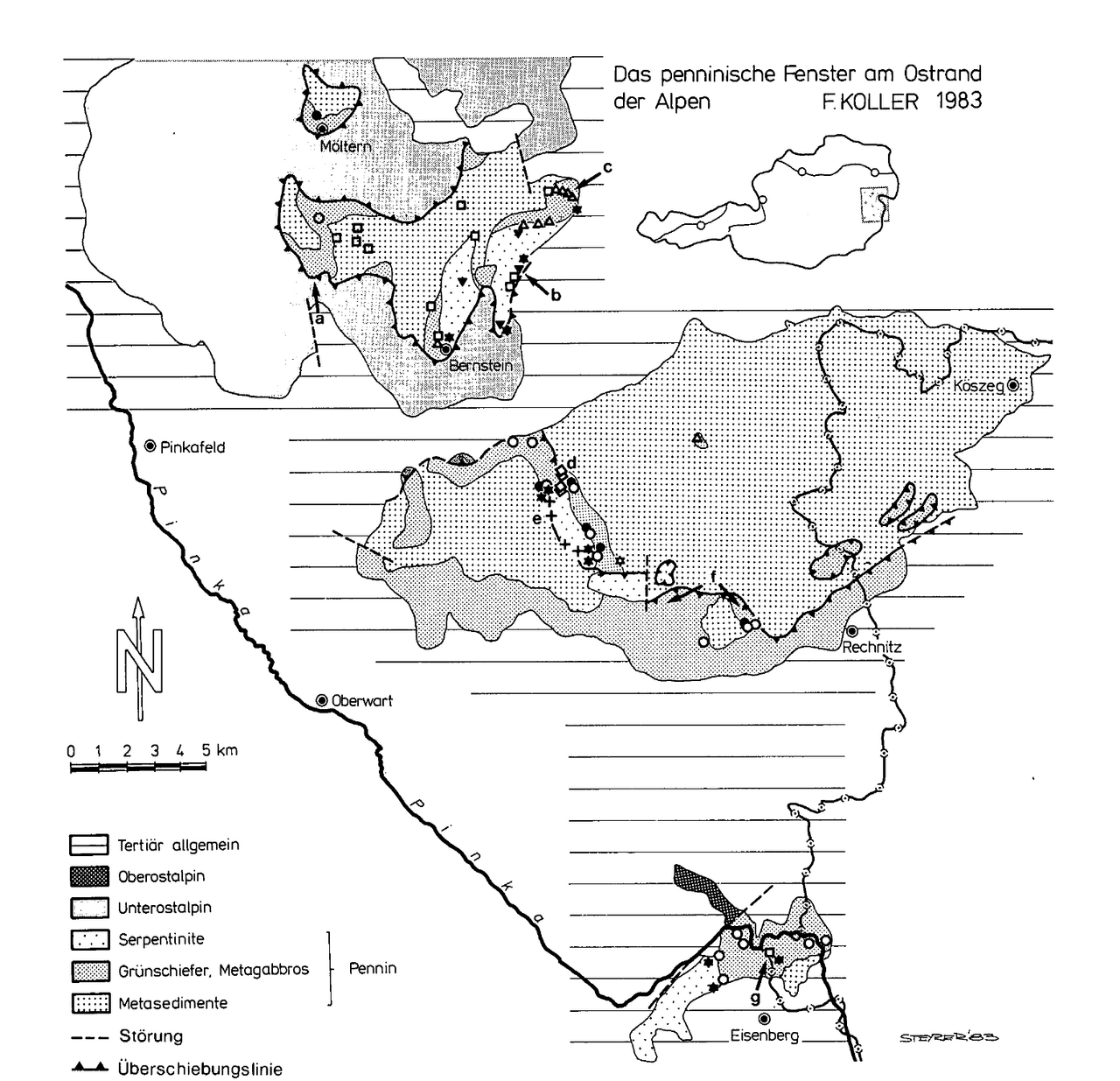
Koller's geological overview (Figure 1 of his paper, reproduced here as a Bildzitat) shows the arrangement of these windows at the eastern margin of the Alps: from north to south the small window of Möltern, then the windows of Bernstein and Rechnitz, with the Rechnitz Window continuing east to Kőszeg in Hungary, and finally the southernmost occurrence at Eisenberg. The map distinguishes serpentinite, greenschist with metagabbros and metasediments. It makes visible that the serpentinite bodies are not isolated individual occurrences but part of a coherent ophiolitic sequence.
Two things follow. First: that asbestos-bearing rock occurs in this region is geologically expectable, not surprising. Second: the asbestos problem is not confined to the label "serpentinite". Metamorphosed basic rocks of the same unit, such as metabasalts and metadiabases, can also carry asbestos according to Van Gosen and Clinkenbeard (2011) where they have been sheared and infiltrated by silica-rich fluids. The lithology label of a quarry in the mining register is therefore not a reliable indication that the material is asbestos-free.
What this means in practice
The geology explains why asbestos in this material cannot be reliably identified by eye: asbestos content and asbestos form vary on a small scale, and several rock types of the same unit are candidates. Only a laboratory analysis gives a sound answer. What the findings look like in the concrete case, which samples were examined and what the measurement methods can and cannot do, is on the Burgenland page and in the methodological context on the standards page.
Sources
- Demény, A., Vennemann, T. W. & Koller, F. (2007): Stable isotope compositions of the Penninic ophiolites of the Kőszeg–Rechnitz series. Central European Geology 50(1):29–46. doi.org/10.1556/CEuGeol.50.2007.1.3
- Evans, B. W. (2004): The Serpentinite Multisystem Revisited: Chrysotile Is Metastable. International Geology Review 46(6):479–506. doi.org/10.2747/0020-6814.46.6.479
- Frost, B. R. & Beard, J. S. (2007): On silica activity and serpentinization. Journal of Petrology 48(7):1351–1368. doi.org/10.1093/petrology/egm021
- Hawthorne, F. C. & Oberti, R. (2007): Amphiboles: Crystal Chemistry. Reviews in Mineralogy & Geochemistry 67:1–54. doi.org/10.2138/rmg.2007.67.1
- Hume, L. A. & Rimstidt, J. D. (1992): The biodurability of chrysotile asbestos. American Mineralogist 77(9–10):1125–1128.
- Klein, F., Bach, W., Jöns, N., McCollom, T., Moskowitz, B. & Berquó, T. (2009): Iron partitioning and hydrogen generation during serpentinization of abyssal peridotites from 15°N on the Mid-Atlantic Ridge. Geochimica et Cosmochimica Acta 73(22):6868–6893. doi.org/10.1016/j.gca.2009.08.021
- Koller, F. (1985): Petrologie und Geochemie der Ophiolite des Penninikums am Alpenostrand. Jahrbuch der Geologischen Bundesanstalt 128(1):83–150. zobodat.at
- Meisel, Th., Melcher, F., Tomascak, P., Dingeldey, Ch. & Koller, F. (1997): Re-Os isotopes in orogenic peridotite massifs in the Eastern Alps, Austria. Chemical Geology 143(3–4):217–229.
- Melcher, F., Meisel, T., Puhl, J. & Koller, F. (2002): Petrogenesis and geotectonic setting of ultramafic rocks in the Eastern Alps: constraints from geochemistry. Lithos 65(1–2):69–112.
- Saccocia, P. J., Seewald, J. S. & Shanks, W. C. III (2009): Oxygen and hydrogen isotope fractionation in serpentine–water and talc–water systems from 250 to 450 °C, 50 MPa. Geochimica et Cosmochimica Acta 73(22):6789–6804. doi.org/10.1016/j.gca.2009.07.036
- Schwartz, S., Guillot, S., Reynard, B., Lafay, R., Debret, B., Nicollet, C., Lanari, P. & Auzende, A. L. (2013): Pressure–temperature estimates of the lizardite/antigorite transition in high pressure serpentinites. Lithos 178:197–210. doi.org/10.1016/j.lithos.2012.11.023
- Van Gosen, B. S. & Clinkenbeard, J. P. (2011): Reported Historic Asbestos Mines, Historic Asbestos Prospects, and Other Natural Occurrences of Asbestos in California. U.S. Geological Survey Open-File Report 2011-1188, 22 pp. pubs.usgs.gov/of/2011/1188
- Wenner, D. B. & Taylor, H. P. Jr. (1971): Temperatures of serpentinization of ultramafic rocks based on O¹⁸/O¹⁶ fractionation between coexisting serpentine and magnetite. Contributions to Mineralogy and Petrology 32(3):165–185. doi.org/10.1007/BF00643332
- Whittaker, E. J. W. (1957): The structure of chrysotile. V. Diffuse reflexions and fibre texture. Acta Crystallographica 10:149–156. doi.org/10.1107/S0365110X57000511
- Wicks, F. J. & O'Hanley, D. S. (1988): Serpentine minerals: structures and petrology. In: Bailey, S. W. (ed.), Hydrous Phyllosilicates. Reviews in Mineralogy 19:91–167.
Questions on the topic? → Contact