What is being treated as a new scandal in Burgenland in 2026 is more than a hundred years old. The asbestos-bearing serpentinite of the Rechnitz window was documented, mined, marketed as a raw material, medically studied and argued in court long before the first Greenpeace sample tube was filled. At almost every point in this history, the knowledge was already there. At almost every point, it did not lead to decisive action.
That this region contains asbestos-bearing rock is geologically expected (we explain the mineralogy of the serpentinite on the overview page). The geologist Friedrich Koller of the University of Vienna put it plainly to Falter: „Asbest bildet sich in den Klüften. In manchen Steinbrüchen, wie in Badersdorf, sind Asbestadern häufiger als in anderen Serpentinit-Steinbrüchen." (Asbestos forms in the fissures; in some quarries, such as Badersdorf, asbestos veins are more frequent than in others.) The question was never whether the asbestos is there. It was what was done with the rock.
The raw material: 1916 to 1945
At first the Rechnitz asbestos was not a by-product but the product. Between 1916 and 1945 it was mined industrially as a raw material in the Rechnitz-Bernstein region. A dedicated AMIANT-Aktiengesellschaft ran the extraction; the first geological reports came from C. Doelter ("The asbestos and talc deposits in Rechnitz", 1922) and O. Ampferer (report on the AMIANT-AG asbestos deposit near Rechnitz, 1926).
How rich the deposit was considered to be was recorded in 1928 by the marketing literature itself: H. Rosenberg, a partner in the micro-asbestos firm Bernfeld & Rosenberg, put the asbestos content of the rock mass at, on average, over 50 percent (lower bound about 25, upper bound about 80 percent) in the Berg- und Hüttenmännisches Jahrbuch. It is an order of magnitude that matches today's quarry-specific range from the agriculture ministry (2 to 100 percent). According to a further report by Rosenberg in the Montanistische Rundschau (around 1936), "micro-asbestos" from Burgenland could be delivered to Germany at very low prices and duty-free, and it was explicitly marketed as a road-building and asphalt filler; a leaflet on the construction of rolled asphalt surfaces from July 1933, quoted there, even named asbestos powder among the fillers eligible under the DIN specifications.
The reach of this trade is documented cartographically.
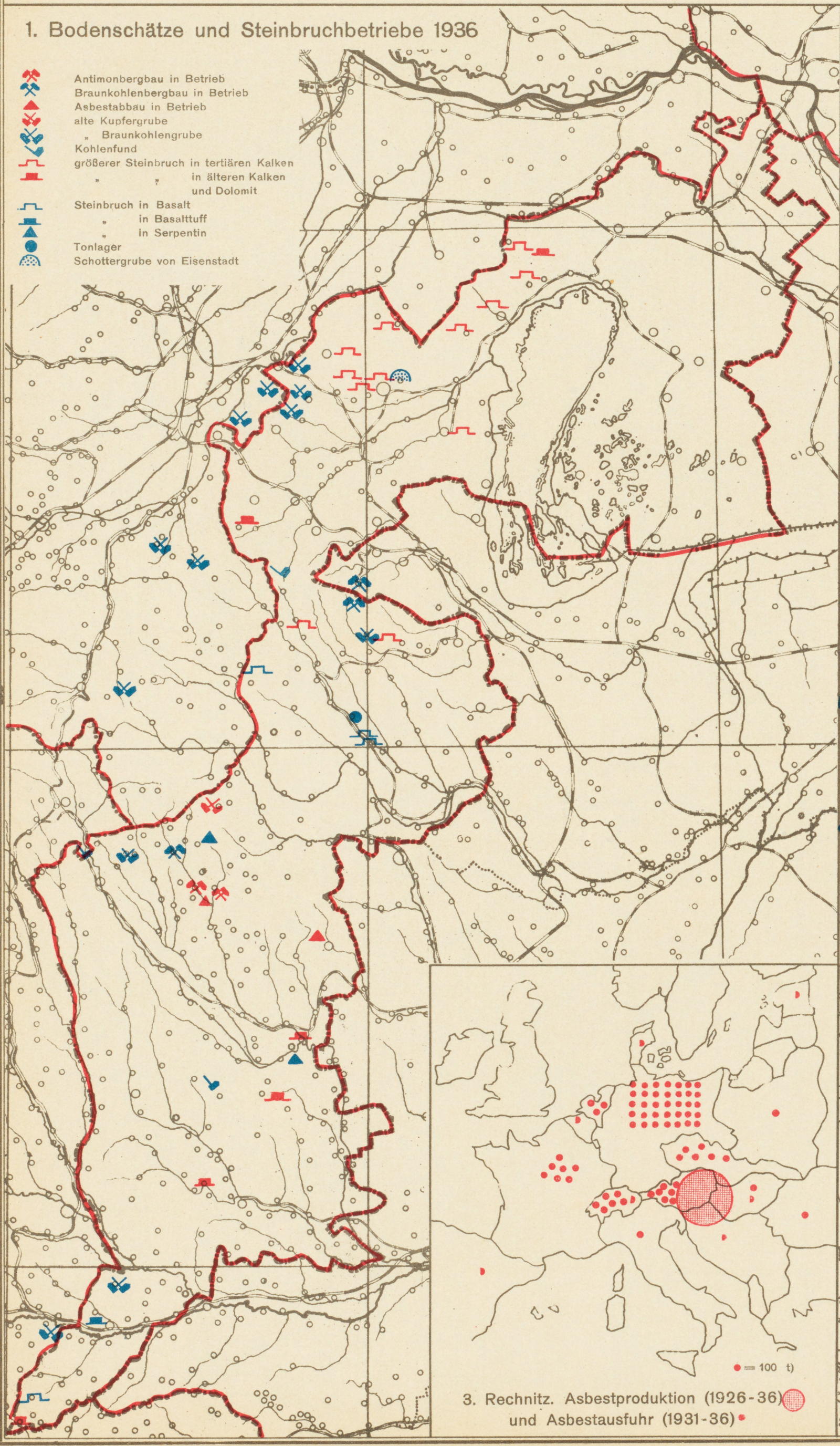
In the Nazi war economy the deposit became of interest across the Reich: in 1938 H. Eggenberger reported on the "searches for asbestos deposits in Austria" by the Deutsche Asbestzement-A.G. in Berlin-Rudow and the Eternit works of Ludwig Hatschek in Vöcklabruck. That prospecting connected the Rechnitz deposit with the Vöcklabruck Eternit processing, that is, with exactly the district that today sits near the top of Austria's mesothelioma map. War-economy reports on the Bernstein serpentinite body followed in 1943. The raw-material mining ended with the war; the asbestos in the rock did not.
The warning: Rechnitz, 1965 to the 1980s
The first medical warning came from the population itself. In 1965 the Rechnitz mason B. J. was admitted to the lung sanatorium at Hirschenstein with a severe lung condition. On the X-rays the doctors found meandering calcifications of the pleura, so-called pleural plaques, an anomaly that occurs almost exclusively in people who have inhaled asbestos fibres. The mason had never worked in any of the asbestos pits.
Reviewing further records of the sanatorium, the physicians found 24 more X-rays with identical pleural plaques, all in patients from Rechnitz, 18 of them with no occupational asbestos exposure at all. The Federal Ministry of Health and Environmental Protection then sent doctors and scientists in the early 1970s. A large study examined the population in three tranches, two years apart. The result was unambiguous: about 10 percent of 300 examined Rechnitz residents showed the asbestos-typical calcifications. In a control group of 600 people from other Burgenland municipalities: nobody. A 68-year-old pensioner, a housewife and vineyard worker who had never worked in a mine, was diagnosed with advanced asbestosis.
In parallel, researchers at the University of Natural Resources and Life Sciences (BOKU) Vienna looked for the source. They analysed the soil of the vineyards, the water of the household wells, the dust from house roofs. They found asbestos everywhere. On 15 April 1979 they measured 3,350 asbestos fibres per cubic metre in the open air of Rechnitz, not at a workplace but in a residential area. In their research report from the early 1980s the authors recorded where the burden came from: from the natural weathering of the stony soil and from the fact that the Rechnitz roads had been gravelled „zum Teil mit asbesthältigem Gestein" (in part with asbestos-bearing rock); tyre abrasion had carried the fibres into the air. Asbestos-bearing building sand had also been used.
It is exactly the constellation of 2026: natural asbestos from the Rechnitz window, released by weathering and by gravelled roads, with measurable consequences for the non-occupationally exposed residential population. The Falter editor Matthias Winterer summed it up in 2026: „Von der Gefahr weiß man jedenfalls schon lange. Aber statt die Ergebnisse der Rechnitz-Studie näher zu studieren, blieben sie im Burgenland unbeachtet. Sie hätten eine Warnung sein können." (The danger has been known for a long time. But instead of studying the Rechnitz results more closely, they went unheeded in Burgenland. They could have been a warning.) A Falter sand analysis from the Pilgersdorf quarry in 2026 found an asbestos content of 8.86 percent, nearly ninety times the 0.1 percent threshold above which asbestos-bearing material counts as hazardous waste in Austria.
Looking away: 1990 to 2011
In 1990 Austria banned asbestos. The ban, however, applied only to deliberately added asbestos; the fibres occurring naturally in the rock did not fall under it, and the serpentinite gravel fell precisely into that gap. The following two decades are a chain of findings and inaction.
In 1994 the ZFE Graz identified chrysotile and actinolite in the Bernstein quarry, classified the material as „schwach gebundenen Asbest" (weakly bound asbestos) and warned of „erhöhtem Gesundheitsrisiko" (increased health risk) during handling and transport. In 1995 the environment ministry wrote to the district authority Oberwart that an asbestos content of more than 0.1 percent had been established in Bernstein; there was „nicht nur eine Expositionsgefahr für die Arbeitnehmer, sondern auch für die Verwender dieses Schotters" (not only an exposure risk for workers but also for the users of this gravel). A closure was considered but not carried out. Instead, in the same year, a counter-opinion by the Austrian Dust Abatement Office concluded that the rock was „nicht asbesthaltig" (not asbestos-bearing). The Burgenland labour inspectorate, according to Falter, relies on that 30-year-old paper to this day; it commissioned no measurements of its own. Its deputy head, Andreas Drivodelits, told Falter: „Das Gestein ist ja dasselbe geblieben wie damals. Warum hätten wir es noch einmal überprüfen sollen?" (The rock has stayed the same as back then. Why should we have checked it again?) That the rock is the same does not, however, support this conclusion: asbestos sits in the serpentinite locally in the fissures, a single negative sample cannot clear so heterogeneous a rock, and the contrary finding of the ZFE Graz and the same year's ministry letter were never reconciled with the counter-opinion. Falter calls it „einen Passierschein zu 30 Jahre langem Wegschauen" (a permit for 30 years of looking away).
In 1999 the matter reached the Administrative Court. Neighbours had objected to the building permit for an asphalt mixing plant in Tauchental: the processed raw material came from a serpentinite quarry and was asbestos-bearing, and the emissions of the released fibres had never been determined. The court found in their favour and annulled the decision for procedural defects; the authority should have engaged with the asbestos objection and determined the pollutant emissions (case 98/05/0044). This ruling, too, brought no across-the-board consequence for the quarries. In 2006 a geological study on asbestos content in the Rechnitz window reached the authorities and led to nothing. In 2008 the responsible minister issued a recall notice for 25-kilogram bags of winter grit from the Postmann (Rumpersdorf) quarry, a one-off; the mining continued. In 2011, finally, the environmental-impact procedure for the Pilgersdorf quarry showed how far the gap reaches: „eine hohe Konzentration von Asbestfasern in der Luft" had been measured, a medical opinion warned that „eine Gefährdung durch Asbest könne nicht ausgeschlossen werden" (a hazard from asbestos cannot be ruled out). The operator's appeal against conditions was nonetheless upheld, on the grounds that in a landscape protection area „rechtlich nur der Schutz des Landschaftsbildes relevant" (legally only the protection of the landscape is relevant). The health hazard could not be examined in law at all.
What remained
The consequences are statistically visible. Austria used around 870,000 tonnes of asbestos between 1947 and 1990 (Federal Environment Agency); in 2022, according to the labour inspectorate, 69 people died of occupational diseases, mainly from asbestos and quartz dust. On the district distribution of mesothelioma, St. Veit an der Glan and Vöcklabruck (the Eternit-Hatschek headquarters) lead; behind them follow Oberwart and Oberpullendorf, that is, exactly the two districts of the quarries sealed in 2026.
That the industry knowledge is old is confirmed by the industry itself. The Styrian firm Scherf replied to a private enquiry in May 2026: „Wir wissen schon seit einigen Jahrzehnten, dass Asbest in Steinbrüchen mit bestimmten Hauptmineralien vorkommen kann (zB Serpentinit Steinbrüche im Burgenland) und haben uns damals schon dazu entschieden, kein Material von potentiell asbestbelasteten Betrieben einzukaufen." (We have known for several decades that asbestos can occur in quarries with certain main minerals, e.g. serpentinite quarries in Burgenland, and decided back then not to buy material from potentially asbestos-contaminated operations.) An employee whose identity Falter protects summed up the inside view: „Bei der alljährlichen Kontrolle der Steinbrüche war Asbest ein Tabuthema. Alle haben es gewusst, aber gesagt hat niemand was. Und gemessen ist auch nie worden." (At the annual inspection of the quarries, asbestos was a taboo subject. Everyone knew, but nobody said anything. And no measurements were ever taken either.)
On 2 January 2026 the four quarries Pilgersdorf, Bernstein, Postmann (Rumpersdorf / Glashütten near Schlaining) and Badersdorf were sealed by the authorities. What happened next, the measurements, the findings, the letters, the escalation into western Hungary, we document continuously on the Burgenland asbestos overview page. The backstory shows: what is new is not the asbestos and not the knowledge of it. What is new is the attention, the current measurements and the cross-border dimension.
Sources
- Falter 13/2026, investigation by Eva Klatzer and Matthias Winterer.
- Falter Maily of 10 April 2026, "Asbest: Die Lungenkranken von Rechnitz", by Matthias Winterer: falter.at/maily/20260410/die-lungenkranken-von-rechnitz. In it, Winterer cites the research report of the study by the Federal Ministry of Health and Environmental Protection (early 1980s).
- Reports of the Geological Survey of Austria, Volume 73 (bibliography for Doelter 1922, Ampferer 1926, Eggenberger 1938, Leitmeier 1943).
- H. Rosenberg, Berg- und Hüttenmännisches Jahrbuch Vol. 76 (1928).
- H. Rosenberg, "Mikro-Asbest (ein faseriger [wolliger] Klein-Asbest) als Füllstoff", Montanistische Rundschau No. 21 (around 1936): duty-free delivery to Germany, marketing as a road-building and asphalt filler, quotation of the leaflet on the construction of rolled asphalt surfaces (July 1933) with asbestos powder as a filler under the DIN specifications.
- Burgenland Atlas 1941, Map 3 (Bodo / Winkler-Hermaden), David Rumsey Map Collection, Stanford Libraries (List No 14534.029).
- Federal Environment Agency (via Falter 13/2026): around 870,000 tonnes of asbestos used in Austria, 1947 to 1990.
- Arbeitsinspektion (Austrian Labour Inspectorate), "Die Tätigkeit der Arbeitsinspektion in den Jahren 2021 und 2022": 69 fatal occupational diseases in 2022, mainly severe diseases of the lungs and airways caused by asbestos and quartz dust. arbeitsinspektion.gv.at
- Written reply by Scherf GmbH to a private enquiry, May 2026; the correspondence is on file with us with the consent of the enquirer and is anonymised at their request.
- Parliamentary answers 4053/AB-BR/2026 (Schumann) and 4055/AB-BR/2026 (Totschnig).
Questions on the topic? → Contact