The name was a promise. "Eternit", from the Latin aeternus, "eternal", was meant to stand for a building material that does not rot, does not burn, does not pass away. A hundred years later the promise has been fulfilled in a way no one intended: the substance in the material, asbestos, really is practically imperishable, and its consequences reach into the present.
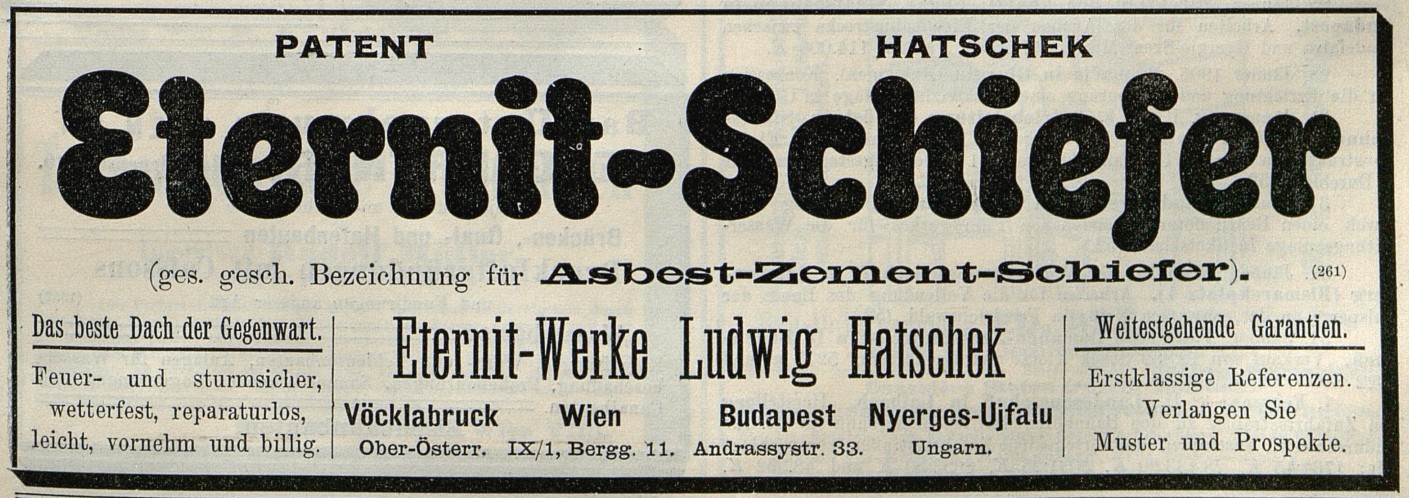
The invention
In Schöndorf near Vöcklabruck, the "Erste österreichisch-ungarische Asbestwarenfabrik" (First Austro-Hungarian Asbestos-Goods Factory) of the entrepreneur Ludwig Hatschek (1856 to 1914) began production in 1893 (Deutsche Biographie; the OÖ Nachrichten date the founding under this name to 1894). At first it made asbestos goods; but Hatschek was looking for a way to manufacture durable, frost-resistant slabs from asbestos fibres and a binder by machine. In 1900 the breakthrough came with Portland cement as the hydraulic binder: finely opened asbestos fibres, mixed with cement and water and formed on a converted cardboard machine into thin, strong slabs. The original recipe consisted of around 90 percent cement and 10 percent asbestos (Stiftung Eternit-Werke Schweiz).
On 15 June 1901 Hatschek was granted Austrian patent No. 5970, a „Verfahren zur Herstellung von Kunststeinplatten aus Faserstoffen und hydraulischen Bindemitteln" (process for manufacturing artificial stone slabs from fibrous materials and hydraulic binders). He had the brand name "Eternit" protected as a word mark in 1903. The idea was compelling: a material as formable as cardboard, as strong as stone, non-combustible, weather-resistant and cheap.
The spread
The material spread quickly across borders. As early as 1903 the first foreign asbestos-cement factory was built in Poissy near Paris, and another the same year in Nyergesújfalu in Hungary; soon sites followed in Bohemia and Moravia, and through licences the process spread to numerous countries in Europe and overseas. Asbestos cement became the material of the modern age: corrugated sheets on roofs and facades, window sills, flower troughs, and above all pipes; entire water-supply networks were built from asbestos cement. Anyone who needed a roof or a pipe in the twentieth century often reached for asbestos cement, and often the material bore the name Eternit.
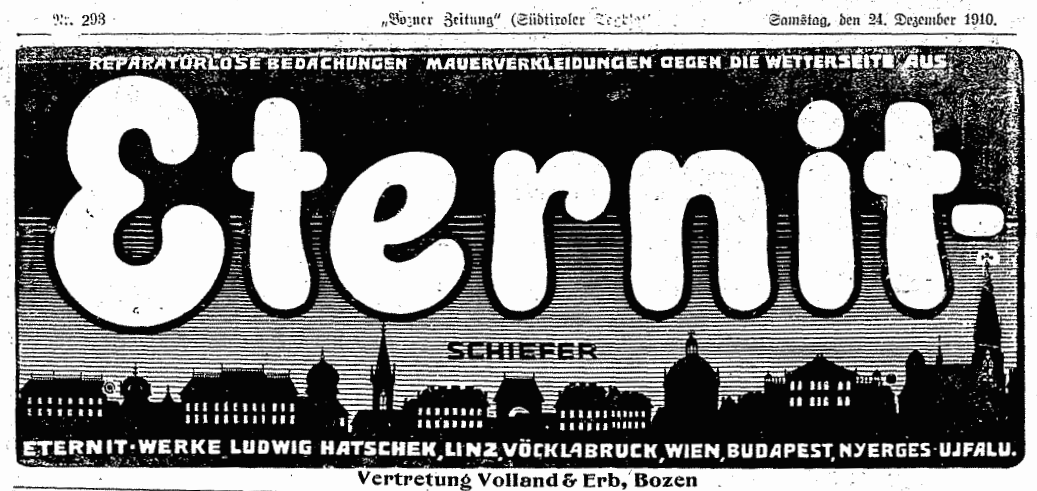

The story of the spread also runs through the Nazi years. In the Second World War the war economy became the Hatschek works' most important market; the firm supplied sheets for barracks and pipes for air-raid protection structures, and it escaped expropriation by the National Socialists through a lease agreement covering the company-owned quarry in Ebensee, in which an oil-refining plant was built. The historian Wolfgang Quatember says of the firm: „Die Firma Hatschek hat selbst keine KZ-Häftlinge angefordert und beschäftigt" (the Hatschek firm did not itself request or employ concentration-camp prisoners), and that it had little influence over what happened on its land, although it had struck what the paper calls a quite "acceptable" deal with the National Socialists; in 1945, nonetheless, 3,226 concentration-camp prisoners were deployed there, among other things in tunnel construction, and around 20 percent of the total workforce were prisoners of war and Russian civilian workers (OÖ Nachrichten).
The health consequences
The catch lay in the asbestos fraction, around 10 to 15 percent in asbestos-cement products (German Umweltbundesamt). Asbestos in hardened fibre cement is firmly bound: as long as the sheet stays intact, it releases almost no fibres. It becomes dangerous as soon as the material is worked or destroyed, when it is sawn, drilled, sanded, broken. Weathering leads to the same end: where roof or facade sheets have become severely brittle and friable through general weathering, they must be removed, and it is precisely removal that carries the risk of fibre release (German Umweltbundesamt). When the material is worked, broken or removed, exactly those microscopic fibres come loose that can trigger asbestosis and lung cancer, and pleural mesothelioma, a tumour of the pleura that arises predominantly from asbestos (more on the medicine: → Asbestos and health). There is, by contrast, no general remediation duty for intact, functional asbestos-cement products (German Umweltbundesamt).
In Austria, between 1950 and 1990, around 30,000 to 40,000 tonnes of asbestos were processed each year, predominantly chrysotile (Arbeitsinspektion). Asbestos was found in a wide range of products, from insulation materials and brake linings to the roofing slabs and pipes made of Eternit. Because the illnesses only appear decades after exposure (Arbeitsinspektion), the intensive use of the post-war decades reaches into the present in its consequences.
Ban and aftercare
Austria sharply restricted asbestos with the Asbestos Ordinance of 1990 (BGBl. No. 324/1990, since repealed): products containing amphibole asbestos were banned with no transitional period of their own, remaining stock could still be handed over until 31 December 1990 (§ 6 para 1); individual product groups such as friction linings for the first-fitting or retrofitting of machinery and industrial plant already in operation or commissioned by the end of 1991, and gaskets and packings, had their own deadlines running to the end of 1993 (§ 6 paras 2 and 3). Asbestos-cement building products for building construction could be placed on the market at the latest until 31 December 1993; for asbestos-cement pipes in civil engineering the ordinance set no such deadline, and their placing on the market ended at the latest with the EU-wide ban. EU-wide, Commission Directive 1999/77/EC completed the ban; member states had to bring the necessary provisions into force by 1 January 2005 at the latest (Art. 2(1)). The basis in force today is the REACH Regulation (EC) No 1907/2006, Annex XVII entry 6: banned are the fibres themselves and articles and mixtures to which they are intentionally added. That the late consequences are not settled is shown by the aftercare: the AUVA offers follow-up examinations to people formerly exposed to asbestos dust at work, organised by the BBRZ, with counselling centres in six cities (gesundearbeit.at, as of 2018). One of them is in Vöcklabruck, where it all began with Hatschek's works.
The Hatschek process has survived: fibre cement boards are still made today, only the asbestos has been replaced by asbestos-free fibres; old and new sheets are visually identical, and whether an older sheet contains asbestos is settled only by analysis (→ Recognising asbestos). The brand itself is receding: the Vöcklabruck company has traded as Swisspearl since 23 March 2023. The renaming became necessary for trademark-law reasons: trademark rights and licences for the production process had been granted since the early 20th century to numerous European and international organisations, and there are no corporate ties to many of the "Eternit" companies that arose from this; the Eternit name remains on well-known products such as corrugated sheets, roofing slates and roof tiles (meinbezirk.at).
The building stock today
Eternit is the story of industrially added asbestos, of a deliberately manufactured material. It explains why buildings erected or renovated before the mid-1990s may still contain asbestos-bearing substance: asbestos-cement products for building construction could be placed on the market until 31 December 1993 and installed afterwards, so the window of suspicion reaches beyond 1990; for pipes in the ground, whose placing on the market ended without a deadline of its own at the latest with the EU-wide ban, it reaches further still. A large part of these sheets, facades and pipes is still in place today; intact, the firmly bound material releases almost no fibres, but when worked, broken, renovated or precisely when removed it becomes dangerous, and while no general remediation duty exists for intact asbestos-cement products, severely weathered, brittle sheets must be removed (German Umweltbundesamt). One therefore does not tear such substance out oneself, but first clarifies the suspicion via an independent accredited analysis. Asbestos-containing waste is hazardous waste in Austria (EU waste code 17 06 05*, key number 31412 for asbestos cement in the Austrian Waste Catalogue Ordinance 2020), and demolition and asbestos-remediation work is carried out by businesses authorised for it by the authorities, in the wording of the ordinance: authorised employers under § 26 of the Grenzwerteverordnung (more on this: → Recognising asbestos).
But there is also the other path by which asbestos reaches buildings and roads: naturally occurring asbestos in rock, used as gravel and grit. That is the story currently unfolding in Burgenland (→ Asbestos in Burgenland). Two different paths, asbestos both times. The fibre types differ, predominantly chrysotile in Eternit, amphiboles as well in the Burgenland rock, and with them the potency; the disease spectrum is the same (→ Asbestos and health). The promise of eternity from 1903 was kept, only not in the way it was meant.
Sources
- Deutsche Biographie, "Hatschek, Ludwig": deutsche-biographie.de (factory in Schöndorf near Vöcklabruck, start of production 1893, company name, Portland-cement process 1900, patent 5970/1901, first foreign works Poissy and Nyergesújfalu 1903)
- Austrian Biographical Lexicon, "Hatschek, Ludwig (1856 to 1914)": biographien.ac.at (Schöndorf near Vöcklabruck; first foreign asbestos-cement factory 1903 in France)
- OÖ Nachrichten, "Hatscheks Patent für Eternit": nachrichten.at (patent No. 5970 of 15 June 1901; word mark "Eternit" 1903, from the Latin aeternus; founding year given there as 1894; NS chapter and war economy after the historian Wolfgang Quatember)
- Stiftung Eternit-Werke Schweiz, "Über Asbest": eternitstiftung.ch (original mixture: 90 percent cement, 10 percent asbestos fibres)
- Arbeitsinspektion, "Asbest: Kein Thema der Vergangenheit": arbeitsinspektion.gv.at (30,000 to 40,000 tonnes annually 1950 to 1990, predominantly chrysotile; latency several decades)
- Umweltbundesamt (Germany), "Asbest": umweltbundesamt.de (firmly bound asbestos in asbestos-cement products, asbestos share ca. 10 to 15 percent; fibre release above all when worked or removed; sheets that have become severely brittle and friable through general weathering must be removed, no general remediation duty for intact products)
- Asbestos Ordinance 1990, BGBl. No. 324/1990: ris.bka.gv.at (§ 2 para 1: amphibole-asbestos products banned with no transitional period of their own; § 6 para 1: remaining stock could be handed over until 31 December 1990; § 6 paras 2 and 3: friction linings for the first-fitting or retrofitting of machinery and industrial plant already in operation or commissioned by the end of 1991, and gaskets and packings, until 31 December 1993; § 4 para 3: placing asbestos-cement products for building construction on the market prohibited from 1 January 1994, pipes not named there; § 6 para 4: goods lawfully placed on the market could continue to be used; the ordinance has since been repealed)
- EU law: Commission Directive 1999/77/EC, OJ L 207, 6.8.1999, p. 18 (provisions to be brought into force by 1 January 2005 at the latest, Art. 2(1)): eur-lex.europa.eu; basis in force today REACH Regulation (EC) No 1907/2006, Annex XVII entry 6: eur-lex.europa.eu
- Waste Catalogue Ordinance 2020, Annex 1: key number 31412 "gn" (hazardous, not reclassifiable, § 4 para 1), asbestos cement: ris.bka.gv.at; the EU waste code 17 06 05* comes from the EU waste list (Decision 2000/532/EC)
- § 26 Grenzwerteverordnung, "Ermächtigte Arbeitgeberinnen und Arbeitgeber für Abbruch- oder Asbestsanierungsarbeiten": ris.bka.gv.at
- Gesunde Arbeit (ÖGB/AK), "Asbeststaub: Es geht um Ihre Gesundheit": gesundearbeit.at (examinations „von der AUVA angeboten, durch das BBRZ … organisiert"; counselling centres in Vienna, Linz, Vöcklabruck, Kapfenberg, Klagenfurt and Innsbruck; page dated 14 June 2018)
- meinbezirk.at (district of Vöcklabruck; community upload reproducing a company announcement), "Eternit wird zu Swisspearl": meinbezirk.at (renaming 23 March 2023 for trademark-law reasons; Eternit name remains on corrugated sheets, roofing slates and roof tiles)
- Images: Eternit advertisement 1905, Austrian National Library (ANNO), public domain; Eternit advertisement Bozner Zeitung, 24 December 1910, via Wikimedia Commons, CC BY 4.0.
Questions on the topic? → Contact